
What is Search Engine Optimization?

SEO for Beginners: How to Rank Websites the Right Way

Introduction:

SEO for Beginners: How to Rank Websites the Right Way.

What is the first step in Search Engine Optimization?

If you ask me this question, my answer is simple: first understand what Search Engine Optimization actually means, and only then move on to the different steps.

Today, many people mention “SEO Specialist” or similar titles in their profiles. But the reality is very different.

Most of them do not understand the proper way to optimize a website or articles. Their primary goal is often just to bring traffic to a website—without focusing on quality or user intent.

In this article, I don’t tell you types and all, but I will give you basic but solid information about Search Engine Optimization.

What Is Search Engine Optimization?

Search Engine Optimization (SEO) is the process of optimizing your website to improve relevance and increase authority by solving user queries.

The most important part of this definition is “solving user queries.”

SEO is not just about optimizing your website for search engines.
It is about solving real user problems through valuable content.

If you want to know how to create an Valuable content then click here, you will get deep knowledge about the content marketing.

My mentor Sanjay Shenoy says:

“SEO is NOT a knowledge problem. It’s an execution problem.”

I completely agree with this.

If you only learn SEO but do not implement it, you will never see results.

Most people consume SEO tips and tricks, implement them quickly, and sometimes even get short-term results. But those results don’t last.

One Google update can push your website to the second page of Google.

And as the famous quote says:

“You can hide a dead body on the second page of Google.”

Very few people visit the second page. That’s why your SEO foundation must be strong.

What is Search Engine Optimization?

How Search Engines Work?

Before learning how to do SEO, you must understand how search engines work.

Search engines work in three simple steps:

1. Crawling

Google crawlers (or bots) scan the World Wide Web to discover websites and content.

They collect:

  • New content
  • Updated content
  • Existing pages

And store this information in Google’s system.

2. Indexing

Once the content is crawled, Google tries to understand:

  • What the content is about
  • Which topic it belongs to
  • The context and meaning

After understanding this, Google organizes the content in its index.

3. Ranking

Finally, based on:

  • Relevance
  • Authority
  • User behavior
  • And more than 200 ranking signals

Google decides where your website should appear in search results. Remember you should always create an content which is more relavent and problem solving content for the readers. so create an quality content.

How Search Engine Works?

Important SEO Factors

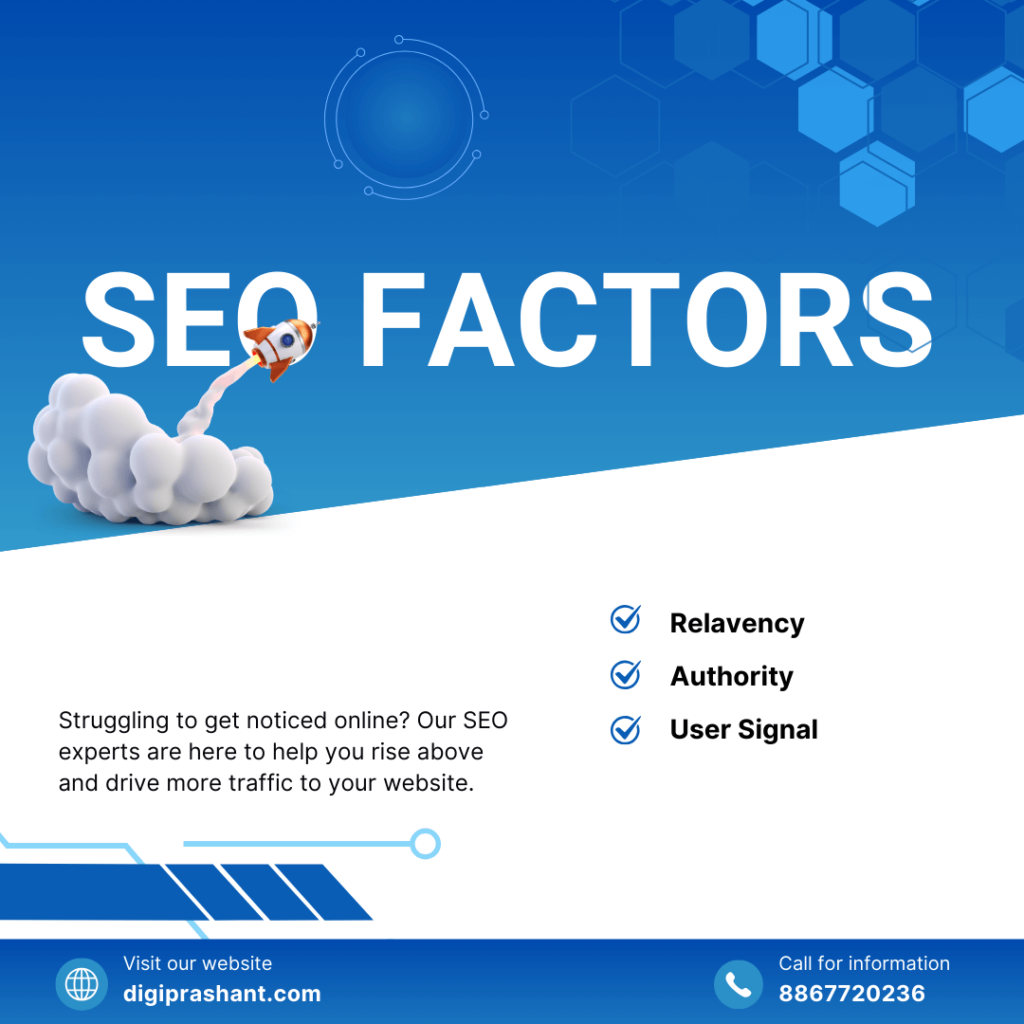
Although Google has over 200 ranking signals, they can broadly be grouped into three core factors:

  1. Relevance – How closely your content matches the user query
  2. Authority – How trustworthy and credible your website is
  3. User Signals – How users behave on your website

All ranking signals fall under these three categories.

How to Check User Behavior on Your Website?

Google Analytics

Google Analytics helps you understand:

  • Where traffic comes from
  • How users interact with your site
  • Time spent, bounce rate, and more

Google Search Console

Google Search Console shows:

  • Organic search performance
  • Keywords you rank for
  • Clicks, impressions, and indexing issues

Both are official Google tools, so you can trust the data completely.

How to Check User Behavior on Your Website?

What Is a Keyword?

A keyword is simply a user query—the word or phrase a user types into a search engine.

Keyword research is the first practical step in any SEO project.

What Is a Keyword?

Types of Keywords

There are three main types of keywords:

1. One-word keywords

Example: SEO

  • Very high competition
  • Very high search volume

2. Two to three-word phrases

Examples:

  • SEO tools
  • SEO online tools

These have:

  • Medium competition
  • Decent search volume

3. Four or more-word phrases (Long-tail keywords)

Example: Most popular SEO tools online

These have:

  • Very low competition
  • Low search volume
  • Very high user intent

Example search volumes:

  • SEO – 13.4K
  • SEO tools – 3K
  • Most popular SEO tools online – 10

Even though the volume is low, user intent is strongest in long-tail keywords.

Search Commercial Intent Funnel

This funnel represents the user’s search journey.

Top of the Funnel – Informational & Navigational

  • 80–90% of total searches
  • Low competition
  • Users want information

Middle of the Funnel – Research & Discovery

  • Medium volume
  • Medium competition
  • Users compare tools or services

Bottom of the Funnel – Purchase / Transactional

  • Low volume
  • Very high competition
  • Users are ready to buy
Search Commercial Intent Funnel

Which Keywords Should You Target First?

If you are starting a blog from scratch, do NOT target transactional keywords first.

Why?

  • Big websites already dominate them
  • They have strong authority
  • New websites rarely rank for them
  1. Start with informational keywords
  2. Build traffic and authority
  3. Move to research & discovery keywords
  4. Finally, target transactional keywords
SEO for Beginners: How to Rank Websites the Right Way

Types of Keywords Explained

Informational Keywords

Users want knowledge.

Examples:

  • What is SEO?
  • Why is SEO important?
  • How does SEO work?

These help build trust and authority.

Research & Discovery Keywords

Users know the problem and look for solutions.

Examples:

  • Best SEO tools
  • Best SEO services

Users compare options and read reviews.

Purchase Keywords

Users are ready to buy.

Examples:

  • Buy SEO services
  • Buy SEO tools

These keywords convert well—but only after authority is built.

Types of Keywords Explained

How to Do Keyword Research

Step 1: List Topic Ideas

Write down all topics related to your niche.

Step 2: Find Seed Keywords

Choose broad keywords with good volume but unclear intent.

Step 3: Choose a Primary Keyword

Select one keyword with:

  • Good volume
  • Low to medium competition

Step 4: Find Secondary & LSI Keywords

LSI (Latent Semantic Indexing) keywords help improve content context and relevance.

Consistency Is the Key

Publishing four articles in one month and staying inactive will not give results.

SEO requires consistent content creation and optimization.

  • Ahrefs (Highly recommended)
  • Ubersuggest
  • Keyword.io

Final Words

This article covers the fundamentals of SEO.

In the future, I will publish more in-depth articles on advanced SEO topics.

If you want to follow me then click here.

Until then,
Take care.

Prashantkumar

Frequently Asked Question

What is search engine optimization?

Search Engine Optimization (SEO) is the process of optimizing your website to improve relevance and increase authority by solving user queries.

How does a search engine really work?

We use a huge set of computers to crawl billions of pages on the web. The program that does the fetching is called Googlebot (also known as a crawler, robot, bot, or spider). Googlebot uses an algorithmic process to determine which sites to crawl, how often, and how many pages to fetch from each site.

What are the important factors of SEO?

Relavency
Authority
User Signals
High Quality Content
User Experiance
Domain Authority

What are the types of Keywords?

Informational Keywords
Research & Discovery Keywords
Purchase Keywords

digiprashant.com

Boost Your Website’s Visibility with Powerful SEO Strategies

Introduction

How to do Search Engine Optimization?

What is the first step in search engine optimisation? If you ask me this question, I will tell you first to understand the meaning of Search engine optimisation then go for the different steps.

Because today most of the people in their profiles are shown as SEO specialists or something else, the reality is very different.

They don’t know the proper way to optimize the articles or your website.

Their main goal is to get traffic to your website.

So in this article, I will give you basic information about Search engine optimization.

What is search engine optimization?

How to do Search Engine Optimization

Search engine optimization is the process of optimizing your website for relevance and increasing the authority of your website by solving user queries.

In the above definition, solving user queries is a necessary term.

It’s not just optimizing your website but solving the user problems through the content that I want to say to you.

My mentor Sanjay Shenoy says, “ SEO is NOT a knowledge problem. It’s an execution problem.”

Do you agree with this?. If you don’t implement what you learn, you don’t get any results.

digiprashant.com

So when you go out and consume content, most probably you get some tips and tricks, and you go and implement those in your website.

You probably get results on it, but it’s not for a long time. One Google update will get you on the second page of Google.

One famous quote is, “You can hide a dead body on the second page of Google.”

So hardly a few people visit the second page of Google. So your SEO basement should be solid.

Before I talk about how to do search engine optimization? First, understand.

How search engine works:

digiprashant.com

Here is the search engine that does most of the jobs for you, which is why you need to know how the search engine works.

There is a three-step process, and I will explain it simply.

  • Crawling:

All Google crawlers or Google robots do is, go out on the world wide web and find all of your websites and take all your content, whether it’s new or updated content, and put it in their records.

  • Indexing: 

Here what is the content all about? To which topic your content is related? What is the context behind your content? All this information will be understood by google bots or crawlers.

Once they get all the information, they organize it.

  • Ranking: 

And it was then, based on the results and relevancy, and other 200 user signals. Your website link will be shown in search engine optimization.

Important SEO factors:

Whatever 200 user signals Google has given, you don’t get a clear idea about those, but it gives you a near idea about those 200 user signals.

But basically, we categorized those into three critical factors.

  • Relevancy
  • Authority 
  • User signals

All 200 signals fall under these three categories.

How to check user behaviour on your website?

  • Google Analytics

Google Analytics gives you an overview of where the traffic is coming from and how users behave on your website all this kind of information you get from here.

  • Google search console

Google search console gives you evident statistics about organic traffic coming in.

Both are Google tools, so don’t have trust issues with those tools.

What is a keyword:

Let us come to what is a keyword.

This is the first step towards approaching SEO projects.

Keywords are user queries, whatever the words or phrases users put in the search engine. 

Keyword types:

There are three types of keywords

  • 1-word keywords :

For example, ‘SEO’ is a 1-word keyword.

  • 2-3 words phrases:

For example, ‘SEO tools’ or ‘SEO online tools.’

  • Four plus words phrases:

For example, ‘most popular SEO tools online.’

Here is one thing you keep in mind, 1-word keywords are very high competition and popularity, and traffic volume is very high.

 2-3 three-word phrases have medium competition and popularity and got enough volume.

Now in 4 plus words phrases, this is significantly less volume and very less competition. 

In the above examples, the ‘SEO’ search volume is 13.4k, for ‘SEO tools’ the search volume of this keyword is 3k,  ‘Most popular SEO tools online’ keyword has a search volume of about only 10.

Out of these three keywords, ‘most popular SEO tools online’ has very high user intent.

Search commercial intent funnel:

Here I called commercial search intent funnel because it’s only related to the search engines.

In this funnel, top of the funnel, you see “informational and Navigational keywords,” Here, the search volume is 80% to 90%, but the competition is low.

And then some set of keywords comes under “Research and discovery” This has enough volume and medium competition.

And then comes down you see purchased or transactional event keywords, which are significantly less volume, but the competition is very high.

I want to ask you one question. What kind of keyword should you target first if you start your blog from scratch?

I know it’s tough to answer this question if you are a beginner.

But you know what? I recommend you start with informational and navigational kinds of keywords.

There is less volume in transactional or purchased keywords but very high competition. Already people write vast numbers of content in these keywords.

They are already ranking for those keywords and have built their authority.

So when you start from scratch, never go for transactional keywords because you never rank on those keywords.

So first, you target informational keywords and start ranking for them, getting enough traffic.

Once you get the traffic or ranking, then your website builds authority.

Then you move to the second stage, which is called research and discovery, where you start ranking for it.

Finally, you go for transactional and purchased category keywords.

Let’s see what kind of keywords these are …

digiprashant.com

Informational keywords:

These kinds of keywords will have what, why, and how. 

For example, What is SEO?

          Why is SEO important?

          How does SEO work?

All these keywords are informational. If the person enters that kind of query, the person wants to know more about SEO.

The person is not looking for anything else. That person wants to know more about SEO.

Would you agree with me?

Once you build the authority of your website, then you say to google that my website is good enough, and now I also rank for other keywords.

digiprashant.com

Research and Discovery: 

After a person knows the solution to their problem, they look for specific tools or products to solve the issues.

Now they click like

For example, 

Best SEO tools.

Best SEO services 

Now they want to search on different tools, which is helpful for SEO, and also, he is looking for a Review of those tools.

Here is the second stage of his research.

Here you need to understand the customer journey. Then only you would be able to rank.

If you properly do this, your website will stay for a long time.

Now we go to the last category.

Purchase:

Now the person understands the kind of products available that resolve their problem.

Now he wants to buy those products or services.

Now he is in the purchase stage, and he wants to buy those products or services.

For example,

Buy SEO services

Buy SEO tools.

What to target first?

  • Informational: High volume and less competition.
  • Research and Discovery: Enough volume and medium competition.
  • Purchase: Less volume and high competition.

How to do keyword research:

Once you understand all of this, the next step is to research keywords.

Four steps are there.

  • List of topic ideas:

Just go ahead and write the list of topics you want to write about in your niche.

  • Find the seed keywords:

Pick up a seed keyword in all the listed topics with excellent volume but not perfect user intent.

  • Choose primary keyword:

Now you find out which one particular keyword you can choose as your primary keyword, with enough volume and less competition.

  • Find secondary and LSI keywords and segregate them.

Here you find secondary and LSI keywords and segregate them.

Here LSI is nothing but a Latent semantic Index, which means these keywords increase the context of your content.

Here is one thing I want to clarify that is consistent with your article. If you publish four pieces in a month and stay idle, you don’t get any results.

For keyword research, I recommend ahref. It’s an excellent tool.

Besides, keyword.io ubersuggest are some essential tools you can use for keyword research.

If you want to know Top digital marketing company in Hubli then Click Here

In this article, you only get the basics of SEO.

In the feature, I came up with other topics related to SEO.

Until then, take care. If you want to Follow me on instagram then click here and Follow or you can follow our linkedIn profile digiprashant.

Thank you

Prashantkumar

What is SEO?

SEO is nothing but an Search Engine Optimization which will help to ake your website in top of the Search Engine Result Page, based on relevent keywords.

What are the Different Types of SEO?

On Page SEO
Off Page SEO
Technical SEO

This are the 3 most important types of SEO.

How to do keyword research?

Once you understand all of this, the next step is to research keywords.
Four steps are there.
List of topic ideas:
Just go ahead and write the list of topics you want to write about in your niche.
Find the seed keywords:
Pick up a seed keyword in all the listed topics with excellent volume but not perfect user intent.
Choose primary keyword:
Now you find out which one particular keyword you can choose as your primary keyword, with enough volume and less competition.
Find secondary and LSI keywords and segregate them.
Here you find secondary and LSI keywords and segregate them.
Here LSI is nothing but a Latent semantic Index, which means these keywords increase the context of your content.
Here is one thing I want to clarify that is consistent with your article. If you publish four pieces in a month and stay idle, you don’t get any results.
For keyword research, I recommend ahref. It’s an excellent tool.
Besides, keyword.io ubersuggest are some essential tools you can use for keyword research.
In this article, you only get the basics of SEO.